
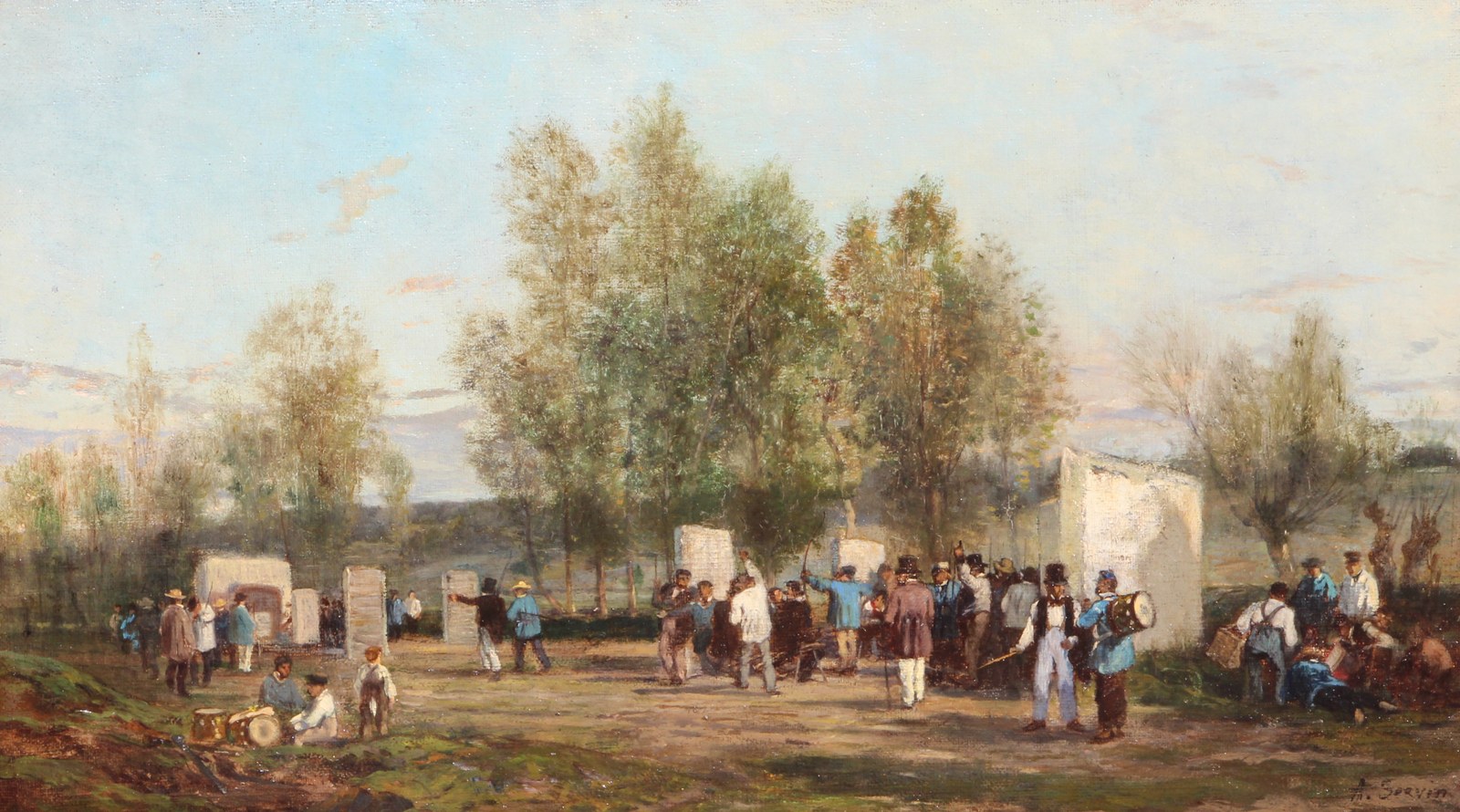
Amédée Servin (1829-1884) · Third quarter of the 19th century · Oil on canvas · 27 × 46 cm · Original title : Le tir à l'arc à Villiers-sur-Morin
The scene takes place in the open air, in that indeterminate space between the village and the fields of which Servin was so fond. In the centre of the composition, two white targets mounted on wooden frames mark out the competition ground: these are the characteristic boards of archery societies, painted white with the concentric black circle that designates the aiming zone. Around these targets is arranged a whole village gathering whose spatial layout reflects the social hierarchy and the roles assigned to each person in this collective entertainment.
On the left, a compact group of archers in dark clothes, some wearing the top hat that signals their membership of the local petite bourgeoisie, others in caps, all standing still as they await their turn. On the right, near a low building that might be an inn or the archery society’s premises, a more mixed crowd of spectators: women in white bonnets, children, men in working smocks. In the foreground, a stray dog and a few objects left lying on the earthen ground. The background is occupied by a row of trees that closes off the horizon, a dark green mass punctuated by a few glimpses of sky. The framing is wide, panoramic, as though Servin wished to take in at a single glance the whole of village sociability gathered together in that moment.
The handling remains faithful to the realist manner that Servin had adopted as early as the 1850s, under the influence of his masters Drolling and Picot, but also of his acquaintance with the Barbizon painters. The brushwork is precise without being fussy, applied in small juxtaposed strokes that build up volumes by accumulation rather than by blended modelling. The trees in the background are treated as a mass, with that attention to variations of green which characterises the plein air landscape painters: one can make out the dark greens of dense foliage, the lighter greens of young shoots, the ochres of the trunks showing through the leaves.
The sky, a pale blue streaked with white clouds, occupies the upper third of the canvas; its diffuse luminosity lights the scene from above without casting sharp shadows, creating that even light characteristic of overcast summer days. The human figures, although small within the overall economy of the composition, are individualised: each has his or her own posture, gesture and particular dress.
Servin does not paint an undifferentiated crowd but a gathering of individuals, each of whom retains an identity of their own. The clothing is rendered with documentary care: the blue smocks of the peasants, the dark jackets of the bourgeois, the white bonnets of the women, the children’s aprons. The overall palette remains sober, dominated by the earthy browns of the ground, the greens of the trees, the whites of the targets and bonnets, the muted blues of the sky and the clothing. Only a few touches of bright red, visible on certain garments or accessories, enliven this measured chromatic ensemble.
To paint an archery competition is to capture one of those moments of rural sociability that gave structure to village life in the 19th century. Archery societies, heirs to the medieval confraternities, enjoyed a revival under the Second Empire and the early Third Republic: they served as meeting places between notables and the general population, between the local bourgeoisie and the peasant world, in a setting that combined sporting competition, communal banquets and the affirmation of local solidarity.
Servin’s composition gives visual expression to this social stratification: the archers in bourgeois dress occupy the left-hand side, the space of action and technical skill; the humbler spectators stand on the right, beside the inn, the place of consumption and conviviality. Between the two, the white targets mark the geometric and symbolic centre of the scene: it is towards them that every gaze converges, around them that collective sociability is organised. Yet what is striking about this scene is its static, almost frozen quality. No one is shooting, no one is gesticulating, no one is running. The figures seem to be waiting, suspended in a dilated time in which nothing really happens. This stillness is not that of the academic pose but that of the interval between two actions, the moment when social time slows down, when the community exists in its mere physical presence before the event sets it in motion. Servin captures the village gathering in its contemplative dimension rather than in its festive bustle.
This canvas belongs to Servin’s most fruitful period, the one that followed his arrival in Villiers-sur-Morin in 1857 and the founding of the Cercle artistique in 1860. Trained at the École des Beaux-Arts in the studios of Drolling and Picot, and exhibiting regularly at the Salon from 1850 onwards, Servin might have pursued a Parisian career in the wake of academic realism. But his decision to settle in a village of the Brie, far from official circles, bears witness to a determination to build a pictorial practice rooted in the observation of one particular territory. Villiers became for him not one motif among others but a geography to be inhabited, a place where painting took its place within the continuity of everyday life.
Archery, a local event that Servin probably witnessed regularly, becomes a pictorial subject as legitimate as interior scenes or river landscapes. The canvas was shown at the Exposition universelle of 1900, sixteen years after the painter’s death, testifying to the posthumous recognition that his friends and collectors strove to secure for him. It then belonged to Georges Lutz, a collector and friend of the painter, and was included in the sale of his collection at the galerie Georges Petit on 26 May 1902, before entering an American collection. This history says something about the reception of Servin’s work: appreciated by a small circle of connoisseurs, never truly consecrated by the institutions, he belongs to that category of artists whose work circulates on the margins of the art market without attaining the renown of the great names of realism.
What Servin shows in this archery scene is not a naive celebration of rural life but a lucid observation of the forms of sociability that organise the village world. The social hierarchy remains visible in the spatial arrangement of the bodies, in the differences of dress, in the separation between those who act and those who watch. Yet this hierarchy does not rule out the possibility of a gathering, of a temporary coexistence around a shared entertainment. Archery functions as a ritual that allows the community to experience itself, to make a spectacle of itself for itself, to produce that moment of cohesion in which differences of status, without disappearing, are momentarily suspended within the common space of the competition.
The stillness that characterises the composition reinforces this ritual dimension: no one moves because the important gesture is not that of shooting but that of gathering, of collective presence. Servin paints a situation rather than an action, a state of rural sociability rather than an event. And in this attention to the ordinary forms of social life, in this refusal of the picturesque as much as of idealisation, the quiet modernity of his gaze is revealed. What remains of these village gatherings when the modernisation of the countryside empties it of its inhabitants, when archery societies disappear for want of participants, when the spaces of collective sociability shift towards the towns? Servin’s canvas captures a world living on borrowed time, a form of social life that would persist for a few more decades before fading away.
Marie Gawlikowski & Grégory Mazet, Galerie de Crécy